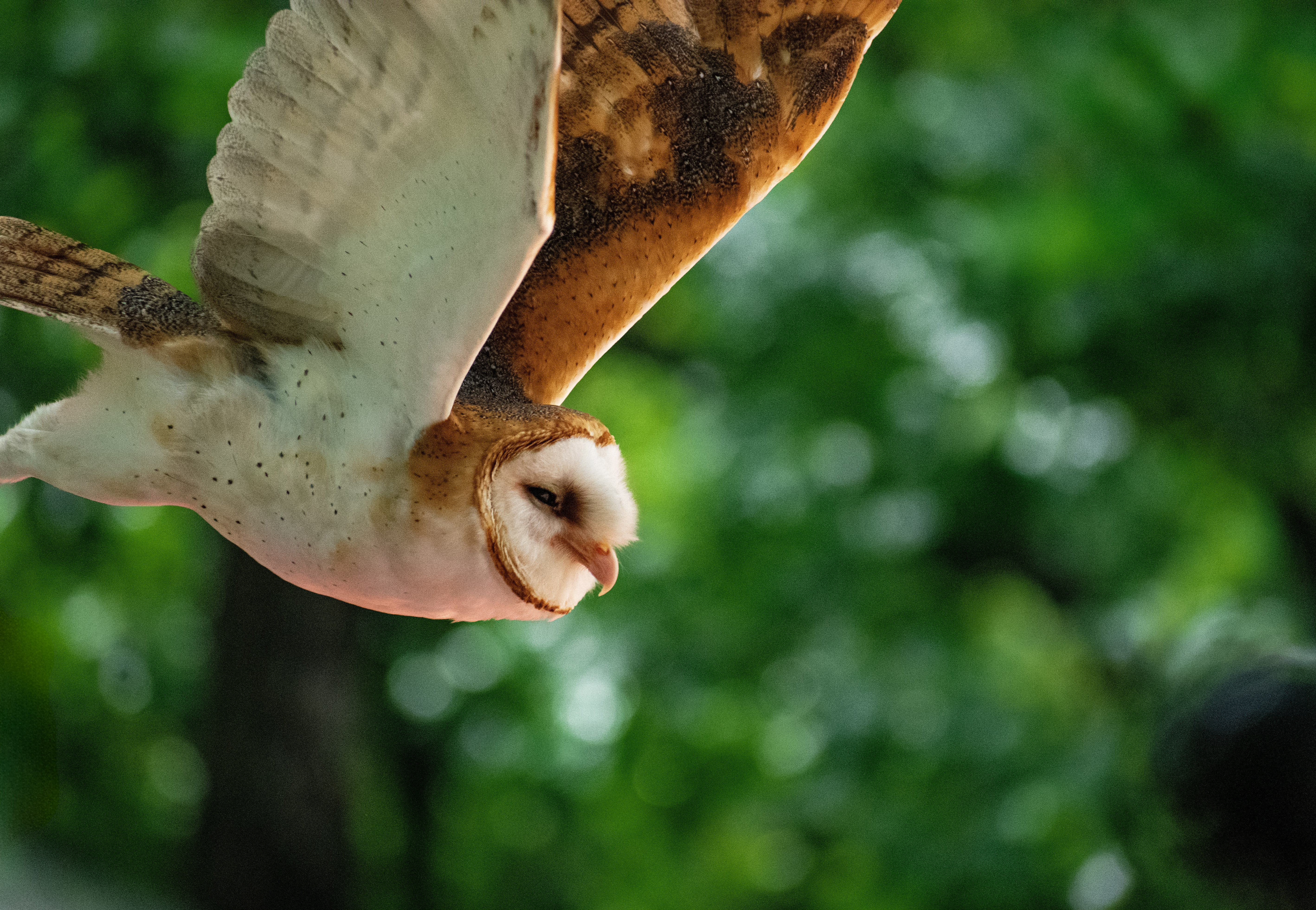
With their silent flight, unusual sounds and tendency to hang out in the shadows, owls have a truly haunting quality that makes them among the more captivating creatures native to Missouri.
We chatted with Kendahl Chergosky, director of education at the World Bird Sanctuary, a raptor hospital in Valley Park, Missouri, that rehabilitates injured birds of prey and works to protect them and their habitats through conservation, rehabilitation and education. Chergosky shared her thoughts on what makes the owl so popular, tips for protecting our feathered neighbors, and a unique opportunity to view them up close this winter.
What kind of owls are native to Missouri?
Missouri is home to eight native species of owls! That includes birds you can see year-round, such as Barred owls and Great horned owls, as well as birds who only come through when migrating, like Northern saw-whet owls or even, very rarely, Snowy owls.
Why are owls so popular?
This is a great question – owls have really captured the human imagination for as long as humans and owls have lived near each other. They have an air of mystery about them, because they’re usually awake at night and can be very well camouflaged. They tend to stay very still when they’re not actively hunting, which may be partly why they’re seen as so wise, as if they’re kind of above the humdrum activity of everything below them. And, if you ask me – they’re also very, very cute. They’ve got big eyes, and they look very soft and fluffy. They really have it all.

Bruno, an Eastern Screen Owl, is a resident at the World Bird Sanctuary. Photo courtesy WBS.
Why are owls sometimes viewed as “spooky”?
This probably goes back to a time well before electricity was invented. Anything lurking in the shadows after dark was automatically seen as “up to no good” in the eyes of most humans around the world. Their nocturnal habits could have made them out to be bad omens – not to mention the noises! Owls don’t just “hoot;” they can make a variety of sounds, even just amongst one species. Barred owls, for example, are known for a distinct call that’s often written out as “who cooks for you, who cooks for you all.” But they can also “caterwaul,” which has been described as sounding like a troop of monkeys. Owls may screech, scream, and cry – all while also flying nearly completely silently, thanks to their soft feathers. This definitely also contributes to the feeling of “otherworldliness,” as if they’re some kind of ghastly apparition, moving silently overhead in the night. Eek!
Do you have any resident owls at the World Bird Sanctuary?
Oh yes! The sanctuary is home to nearly 40 permanent resident owls, representing 10 different species. The conservation of owls has been a major focus of our organization over the years, mainly through the propagation of Barn owls. Populations of these birds have been in decline across the Midwest for several decades, mostly due to human influences (such as habitat loss and the use of rodent poison). In our nearly 50 year history, we have bred and released over 1,200 Barn owls back into the wild. We have active breeding pairs in every county in the state, and these birds are no longer considered endangered in Missouri. Though our focus has been on releasing these birds, we also have several permanent-resident Barn owls who act as ambassadors for their species. By helping to educate the public about the importance of owls, we can help prevent these birds from becoming endangered once again.
Do you have any tips for viewing owls in the wild?
“Viewing” owls can be a challenge, as these animals are incredibly well camouflaged. You’d be shocked at how well even a mostly-white bird like a Barn owl can disappear into a tree. When trying to find owls, I always recommend people use their ears before their eyes. There are free apps people can use to help identify the bird calls they might be hearing, like Merlin Bird ID. When using these apps, though, I always caution people against overuse of the playback function. Sometimes, people may play an owl call to try and prompt a response from a bird in their backyard. This can have some unintended consequences, because overusing these calls can actually drive away your neighborhood birds. A wild owl may take it to mean that the territory is already occupied!
You don’t necessarily have to just listen for owls, either. During the day, sometimes other songbirds can signal that there is an owl nearby by making a fuss! Intelligent birds like crows and bluejays may “mob” owls in their territory, because they know that a predator left near their roost overnight may be just as likely to turn them into a midnight snack! If you ever hear a sudden cacophony raised by a group of songbirds, there is a good chance that there’s some raptor nearby.

Picking up trash and turning off lights after dark are easy ways to help protect our feathered neighbors. Photo courtesy World Bird Sanctuary.
What can we do to protect owls?
There’s so much that we can do in our day-to-day lives that can benefit the animals we share our neighborhoods with. Even simple things which require very little extra effort, like turning out the lights after dark, can be a huge help to migrating birds this time of year.
Owls are some of the most common patients that end up in our wildlife hospital, and the main cause of injury for birds that come into our care is vehicle collisions. It doesn’t mean they’re bad drivers! It just means that, even though they can turn their heads quite far, they still don’t know to look both ways before they cross the street. Medians and shoulders can be an attractive place for owls to hunt, especially when litter attracts prey like mice. By avoiding littering, and sorting trash into appropriate receptacles, we can keep owls (and many other birds!) safer.
Can you tell us a little about the World Bird Sanctuary’s Owl Prowls?
Owl Prowls are one of my favorite activities that we offer at World Bird Sanctuary! These are evening-time programs where we get up close with our resident ambassador owls. First, we do a presentation in our classroom, where several of our owls fly right over your head! We talk about all the traits which make these birds so interesting, as well as some ways people can help their native owls. Then, we go for a night-hike (the “prowl” portion) around the grounds of the sanctuary. Many of our resident owls are much more active at night, so we’ll often see them moving around their aviaries more than we would during the daytime. We’ll also listen for wild owls in the woods. The sanctuary sits on over 300 acres of forest, and we’ve heard six of the eight species native to Missouri over the years!

Learn more about Banshee, an American barn owl, and other owls on an Owl Prowl. Photo courtesy World Bird Sanctuary.
What makes this a great time of year to spot owls in nature?
We run these programs beginning in October, all the way through March, since this is the time of year when owls are often most active. These birds are some of the first raptors to begin establishing a territory, finding a mate, and having young for the year. We’ve even gotten baby Great horned owls into our wildlife hospital as early as January before. While these busy birds are starting a family, they’re more mobile and noisy than they are throughout the rest of the year.
What are some other ways to learn about owls through the World Bird Sanctuary?
If you’re looking for a romantic evening surrounded by birds, I recommend our Owlentine & Wine event in February. This adults-only program dives a little deeper into the courtship habits of our feathered friends. We also supply wine and chocolates! This event generally sells out very quickly, so keep an eye out for once tickets are live.
World Bird Sanctuary is open to the public 8 a.m. – 5 p.m. daily, excluding Christmas and Thanksgiving. Birds are out and about even in the winter, and some, including owls, actually prefer the cold weather. Visit the World Bird Sanctuary’s Events Page to purchase tickets for Owl Prowls and other upcoming events.
If you’re not able to visit the World Bird Sanctuary in person, get to know their residents by following WBS on Instagram, Tiktok, and Twitch, where the sanctuary livestreams its owls 24/7.
World Bird Sanctuary is located at 125 Bald Eagle Ridge Rd., Valley Park, Missouri.
Kathryn Deters McDonald is a Missouri native, writer, author and lover of all things spooky, ooky and eerie. Salem, Shmalem. It’s all right here in The Spook-Me State.


Leave a Reply